
E-Invoicing is considered one of the most critical steps Saudi Arabia is taking on its journey toward digital transformation.
The e-invoicing system is not merely a replacement for traditional paper invoices; it is an essential tool to improve financial transparency and reduce tax evasion.
Many companies face challenges in implementing the invoicing system, but with accounting software compliant with e-invoicing, the transition has become much smoother.
E-invoices help achieve compliance with the requirements of the Zakat, Tax and Customs Authority (ZATCA), in addition to providing comprehensive financial management. Transitioning to e-invoicing software requires time and effort, but the long-term benefits are well worth it. Companies that adopt this system early will be better positioned regulatorily and financially.
Contact Us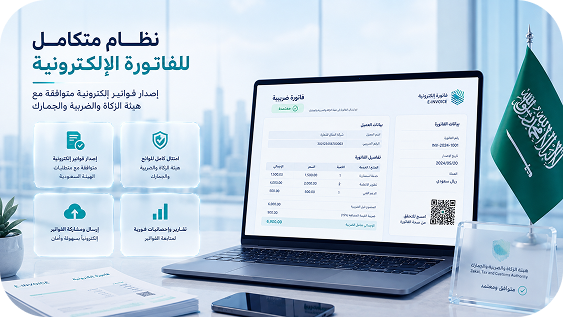
What is E-Invoicing?
An e-invoice is a digital document that replaces traditional paper accounting invoices. This means you do not need to deal with paper or print invoices.
Everything exists digitally within the system.
The e-invoicing system is approved by competent authorities such as ZATCA.
Therefore, specific conditions must be met in an e-invoice for it to be valid and acceptable.
Data must be stored securely and can be updated or modified easily through the system itself. The main goal of e-invoicing is to facilitate commercial transactions between businesses and consumers, and to help organize financial transactions better than regular invoices.
Objectives of Implementing E-Invoicing
Stages of Implementing E-Invoicing in KSA
Generation and Archiving
- Completely phase out manual invoices
- Include a QR code on e-invoices issued to individuals
- Include the buyer's Tax Identification Number (if registered)
- Medad ERP system is fully compliant with this phase
Integration and Connection (Starting 2023)
- Issue invoices in two formats: PDF/A-3 and XML
- Support digital signatures, encryption, and UUID to ensure data integrity
- Direct integration with ZATCA's "Fatoora" platform
- Internet connection is required to send invoice data to ZATCA
- Gradual implementation based on targeted business waves
Wave Timeline and Corporate Compliance
Phase 2 of E-Invoicing was launched based on business categories according to their annual revenue, for example:
- Wave 11: For establishments with revenues exceeding 15 million SAR in 2022 or 2023, with the compliance period set from November 1, 2024 to January 31, 2025.
- Announcements are made at least six months prior to the compliance date.
Why is Compliance with Both Phases Important?
- Verified electronic generation effectively promotes transparency and curbs tax evasion
- Saves time and reduces costs compared to paper documentation
- Enhances internal control and accounting within establishments
- Boosts trust among establishments and clients through data security and reliability
Types of E-Invoices
Tax Invoice
Issued between business entities (B2B) for all commercial supplies.
Simplified Tax Invoice
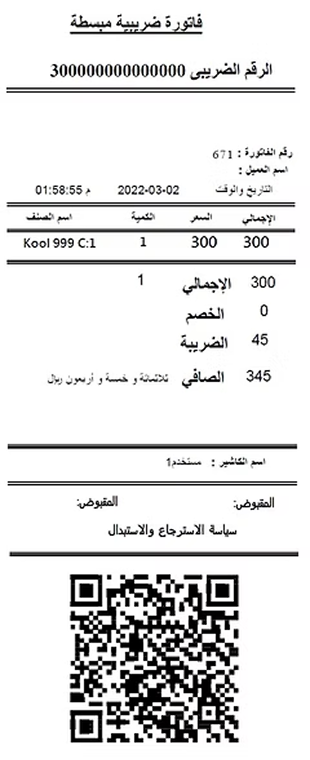
Issued to end consumers (B2C), printed in paper format with a QR code.
Credit and Debit Notes
Used to adjust amounts or cancel transactions related to issued invoices.
Frequently Asked Questions About E-Invoicing
Yes, all modern approved ERP systems allow seamless integration and direct connection with ZATCA.
Phase 2 (Integration Phase) started on January 1, 2023, gradually across specific waves based on annual revenue thresholds.
It can be generated through compliant accounting software or ERP systems that support required fields and output XML or PDF/A-3 formats with a QR code.
Cost depends on company size and system features. Numerous software solutions offer flexible subscription plans for small, medium, and large enterprises.
Phase 1 (Generation and Archiving) began on December 4, 2021, for all taxpayers subject to the e-invoicing regulations.
An e-invoice is structured digitally (XML or PDF/A-3) containing essential elements like Tax ID, QR code, and digital signatures.
The integration phase sends generated invoice data directly to the "Fatoora" platform to verify technical compliance upon issuance.
It is issued directly through your compliant accounting software after entering sales details, generating the e-invoice automatically for the client and platform.
It is software or a tool used to scan and decode QR code data on invoices to verify tax accuracy and regulatory compliance.
Codes can be searched using standard coding guides (such as GS1 or GPC) available through the ZATCA portal or integrated accounting systems.
Yes, QR codes are mandatory on simplified tax invoices (B2C), embedding information like business name, tax number, timestamp, and tax total.
Invoices cannot be altered or deleted once generated. Corrections must be handled by issuing an associated Credit Note or Debit Note.
A Tax Invoice is a legal document containing tax details, whereas E-Invoicing refers to the technical and digital method required to issue and process it.
Adjustments are made via Credit/Debit Notes promptly upon discovering errors, according to ZATCA executive regulations.
Requirements include using an approved tamper-proof system, XML or PDF/A-3 formatting, digital signatures, and direct internet connection to the "Fatoora" platform.
Yes, all establishments registered for VAT are mandated to adopt e-invoicing regardless of whether they are sole proprietorships or corporations.
Rejections occur if mandatory fields are missing, tax calculations are incorrect, or digital signature/encryption checks fail.
Arabic is mandatory for issuing e-invoices in KSA, though English translation can be added alongside the Arabic text.
Systems must prevent anti-tampering, support internet connectivity, generate QR codes, and utilize cryptographic stamps for ZATCA integration.
Data is transmitted automatically via integration APIs to ZATCA, and must be archived securely on local servers within KSA for the statutory period.
No, the e-invoicing regulation applies specifically to taxpayers registered for Value Added Tax (VAT) in KSA.
Yes, ZATCA allows businesses to voluntarily join the integration phase prior to their mandatory wave enforcement date.
E-invoicing does not apply to non-resident taxable persons who do not have a permanent establishment in the Kingdom.
Regulations mandate keeping electronic invoices and associated notes securely for a minimum of 5 years.
Invoices can be shared digitally via email (PDF/A-3 / XML) or printed with a QR code for consumer transactions.